
Throat Damper Replacement
Swapping out a cracked or seized throat damper at the firebox for one that actually closes.
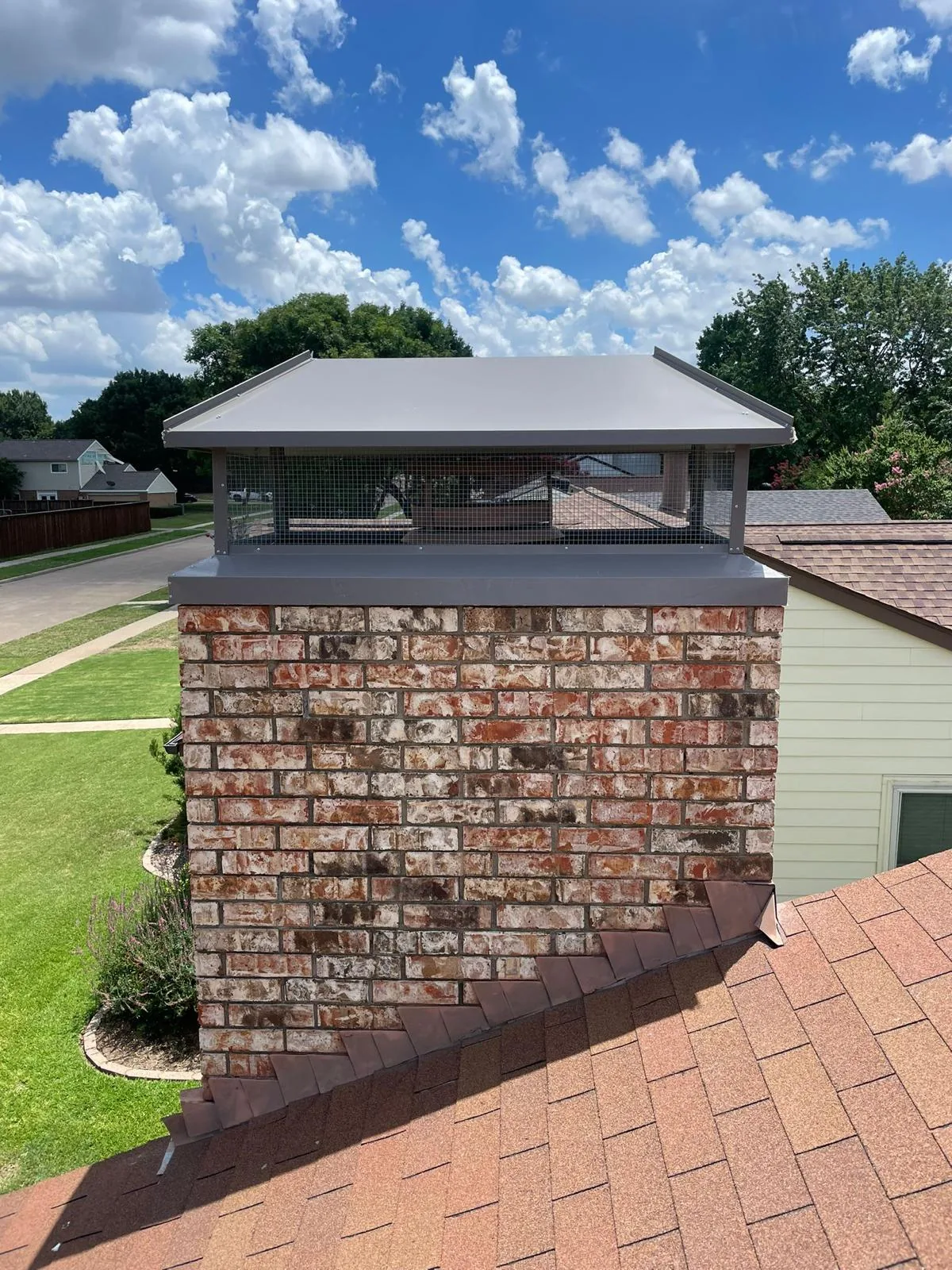
Learn moreAn uncapped flue is an open hole in your roof. Rain runs straight down it, squirrels and birds move in every spring, and stray embers can drift out over dry shingles. A cap fixes all three. We measure your flue, fit a stainless steel cap with mesh sides, and anchor it to stand up to Texas wind. Already have one? We check it at every visit anyway — caps loosen and rust quietly, and replacing one early is far cheaper than drying out a waterlogged flue later.
Prices shown are starting estimates and may change with the condition, access, and scope we find on site. Only a written quote from an on-site visit is a price we commit to.
Bronze or stainless cap with spark arrestor, fully custom-fabricated to your flue.
Drag the model to rotate — see exactly where this component lives in your chimney.
A chimney cap is the smallest component on the stack and one of the most consequential, and PCS Services treats it accordingly. Think of the cap as a little roof over the open flue: its overhanging lid sheds rain and snow away from the flue and the crown, and its surrounding collar keeps birds, squirrels, and raccoons from dropping in to nest. An uncapped flue is an open drain and an open door — water that rots the damper, stains the firebox, and saturates the crown, plus wildlife that blocks the vent. How this differs from our spark-arrestor service: this page is about the weather-and-animal lid; a spark arrestor is the ember-stopping screen, a separate fire-safety function that can be built into a cap but is sized and code-driven on its own terms.
We fit the cap to the chimney rather than forcing a generic part, because the cap's whole value is the seal it makes against water and animals. For a single round or square flue tile, a stainless lid-and-collar cap mounts by band-clamp or screw-on around the tile. For an oversized or non-standard tile where a slip-in won't seat, we use a band-around cap that clamps the tile or fabricate a stainless adapter collar so the lid still covers the opening fully. For a multi-flue masonry chimney, the premium answer is a custom-fabricated outside-mount cap that covers the entire crown and every flue at once, anchored to the masonry — one watershed top that protects the crown and all the flues together. We build in stainless or copper, because a galvanized cap that rusts out in a few years reopens the very flue it was supposed to keep sealed.
Some flues need more than a stock lid, and matching the right cap to the situation is the judgment we're there for. A chimney that's never drafted well in gusty wind can be cured with a draft-increasing vacuum cap that uses the wind to pull smoke up rather than fight it. A flue too short to meet the 3-2-10 termination rule — three feet above the roof penetration, two feet above anything within ten — needs a height-raising extension or shroud, not just a cap, and we'll tell you when that's the real fix. A transitioned or non-standard flue top may need a fabricated collar adapter so a quality cap can seat at all. These are the cases where a generic cap simply fails to seal, leaving the weather and the wildlife right back in.
When a cap has blown off in a storm, an open flue is immediately taking on rain and wildlife, so we offer emergency same-day re-securing or a temporary cover while we source the permanent lid. And when a missing cap has already let animals in, we pair a snug, securely-mounted cap with the cleanup so the same flue doesn't become a nest again next season — keeping animals out is the cap's job, where catching escaping embers is the spark arrestor's. The same material standard and the same fit-to-the-chimney discipline apply across our national network. A cap is a small line item, but on a premium chimney it is the difference between a sealed top and an open one — the quiet guardian against water and wildlife you never have to think about again.
At PCS Services, a chimney cap installation is never guesswork. We scope every job from a graded, photographed inspection first — the NFPA 211 level the evidence calls for — so the work is matched to what your flue and masonry actually need, with the report to prove it. The documented inspection is the record the chimney cap installation is built on.
Chimney inspectionA chimney cap installation isn't a matter of opinion — it's held to published national standards. PCS builds every job to the named codes below and documents it, so the work is provably right for an inspector, an insurer, or a future buyer. These are the universal standards; your city's permit and inspection requirements are confirmed with the local authority before we pull the job.
The flue must terminate at least 3 ft above the point it passes through the roof, and at least 2 ft above anything within 10 ft. A cap sits on top of this height — it can't lower a short flue, so where the flue is too short the honest fix is a height extension, not just a cap.
On a multi-flue masonry chimney, a single custom outside-mount cap covers the entire crown and every flue at once — one anchored watershed top protecting the crown and all flues, rather than separate lids that leave the crown exposed between them.
The cap seals the flue against rain intrusion and wildlife entry — the leading cause of damper rot, firebox staining, saturated crowns, and blocked-vent draft failure. This is the cap's defining function, distinct from the ember screen of a spark arrestor.
Codes cited are the established national standards (NFPA, UL, IRC) that govern this service. The adopted code edition, permit, and inspection requirements vary by city —PCS verifies them with your local authority having jurisdiction on every job.
Exact flue dimensions taken; single-flue or multi-flue outside-mount determined.
Stainless or copper lid sized to seal the opening against rain and wildlife.
Lid fastened and the collar sealed to the tile so wind can't lift or leak it.
Confirm a full weather-and-animal seal, then photo-document for your records.
We've worked on 0+ DFW homes over 15+ years. Every job — small sweep or full rebuild — runs the same way: certified technicians, written quotes, photo reports, warranty in writing.
Stainless and copper lids — they don't rust open and re-expose the flue
Custom-fit to your exact flue, so the seal against rain and animals is real
Outside-mount caps that cover the whole crown on multi-flue chimneys
Storm same-day re-securing so an open flue isn't taking on weather
Family-owned, licensed and insured, working to NFPA 211. We're the team you call when you want it done right the first time — no rotating subcontractors, no upsell pressure, no surprises. Same techs, same trucks, same standard.
One full visit a year: a complete sweep, a top-to-bottom inspection, and a photo report you keep. Between visits you get the part you can't see — we track your schedule, send the reminders, and hold priority slots for plan members during the fall rush. If a repair ever comes up, you get a written quote first. There's no contract; the plan renews only if you want it to.
Before we leave your first visit, next year's window goes on our calendar. When it gets close, we reach out — text or call, your choice — and you pick the exact day. If you don't answer, we try again. That's the entire trick of the plan: your chimney gets maintained because someone whose job it is remembered, not because you happened to.
Honestly, no. If your chimney was built or fully relined in the past year, wait — it doesn't need a plan yet, and we'd rather tell you that than sell you one. Same if you have a gas-only fireplace you light twice a winter: an inspection every year or two covers you. Plans earn their keep for wood burners and busy households. On the fence? Ask. We'll tell you straight.
Late spring through summer is the smart window. The chimney's done for the season, everything winter did to it is visible, and appointments are easy to get. Most people call in October instead, when the calendar's slammed and the first cold front is a week away. Either works. But book in June and you'll never think about it in October.
Because the first cold snap is the chimney trade's alarm clock. From September through November, everyone who forgot their fireplace all year remembers it in the same two weeks, and every sweep in Dallas–Fort Worth is booked solid. It's the worst time to need an appointment, and it's the whole reason our plans schedule you automatically before the crowd shows up.
Last reviewed:
Other services in the Installation category.
Free written quote. Same-week scheduling. 24/7 emergency response when you need it.
Active leak, animal in flue, post-fire damage, or smoke event? Real humans on the line 7 AM to 12 AM every day — replies in under 2 minutes. Tech dispatch within 2 hours during business hours, subject to crew availability after-hours.
Emergency line